Tuesday, April 7, 2009
BioPak 240R Refresher
Members from two of the Boston Fire Department’s seven technical rescue companies attend Biomarine BioPak 240 Revolution closed circuit SCBA refresher training for tunnel rescue. The firefighters must breathe the SCBA for a minimum of one hour. According to OSHA 1910.800, Underground Construction, rescue teams must review the use and limitations of breathing apparatus not less than annually.


Saturday, January 31, 2009
Training Setbacks
 In these tough economic times, people only have enough money to spend on the bare necessities. And that includes the fire service. The division that the Boston Fire Department’s Special Operations Command (SOC) is attached to had to cut its expenditures by ten percent. As you can imagine, that expenditure cut has affected our equipment purchases, out-of-state travel for training and our ability to pay overtime for our technical rescue and hazmat adjunct instructors that augment our SOC cadre.
In addition, we’re losing SOC’s current training facility due to a Harvard University building project called the Harvard Allston Science Complex. Harvard has been gracious enough to let us use another of its buildings in the adjacent Brighton neighborhood. However, we’ll be starting from scratch as far as preparing the building for training. Offices and classrooms have to be built as well as replicating the training props.
There was a glimmer of light that came through those dark clouds in the beginning of the week. We had a windfall of $350,000 that has been earmarked to spend on equipment for our seven technical rescue companies. That was good news. The money came by way of Urban Area Security Initiative (UASI) funding to the Metro-Boston Homeland Security Region (MBHSR).
We’re taking it one step at a time toward re-establishing ourselves. With any luck, we’re be back up and running in a couple of months.
Tuesday, December 9, 2008
1st WMD CST RIT Operations
The Boston Fire Department’s Special Operations Command (SOC) Technical Rescue Section collaborated with the Massachusetts 1st Weapons of Mass Destruction Civil Support Team (1st WMD CST) on Rapid Intervention Team (RIT) operations. The 1st WMD CST was interested in sending some of its members through our training props and we were happy to accommodate them.
The 1st WMD CST members navigated through our wire entanglement and low profile props. In addition, we set up a basic rescue scenario for them in our 2-story 40’ x 20’ maze building and our duplex collapse building.
Though the 1st WMD CST does not operate its RITs the same way as the Boston Fire Department, the fundamental principle is the same – have a RIT standing by at an incident ready to rescue one of its members should the need arise.
Saturday, November 8, 2008
Confined Space Rescue
Our Special Operations Command (SOC) Technical Rescue Group conducted a 2-day confined space rescue program for the Technical Rescue Companies. The second day included two scenarios. One scenario required a vertical entry and the other a horizontal entry.
Vertical Scenario
Workers did not shut off a transformer and subsequently were electrocuted. Worker #1, at the bottom of the shaft, received burns, a broken arm and a broken leg. Worker #2 received massive traumatic injuries and was unconscious.
Horizontal Scenario
A worker was overcome by hydrogen sulfide (H2S) in an old sewer line.
Tuesday, October 14, 2008
TEEX Advanced Structural Collapse 3 Course Slideshow
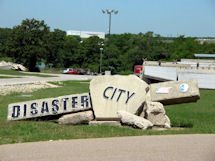
October 6 -10, 2008: The slideshow showcases the various exterior shoring that we were required to construct during this 50-hour course as well as some of the Disaster City® props.
Monday, October 13, 2008
TEEX Advanced Structural Collapse 3 Course
 This month, I and 6 other Boston fire fighters attended TEEX’s Advanced Structural Collapse 3 course in College Station, Texas. This course is 50 hours, five days in length, ten hours of instruction each day and challenges the Structural Collapse Technician with advanced exterior shoring problems. The student expands his/her knowledge of wood shores with multiple insertion point shores, shoring of arches and breached openings. It concludes in an intensive and realistic daytime exercise in which the students employ skills learned during the course. The students are provided multiple scenarios requiring a combination of advanced rescue and shoring techniques.
Thanks to our instructor, Mike Walters, for conducting such a great course.
Highline Operation
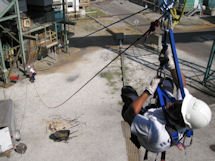
 After packaging and then extricating a victim from the bottom of a vertical 3 stories high 26-inch diameter pipe, the Boston Fire Department Technical Rescue Companies move the victim down to the ground. A Sloping Kootenay Highline System was rigged on the fourth floor of a tower in the rear of Engine 2's and Ladder 19's firehouse to facilitate the extrication.
This was the second day of a 2-day Confined Space Rescue course that our Special Operations Command (SOC) Technical Rescue Group conducted for the Technical Rescue Companies. We did this scenario during the last week of September with 4 of our Technical Rescue Companies. We will run this 2-day class again the last two weeks of the month with the 3 other Technical Rescue Companies plus Cambridge, Massachusetts' Rescue 1.
Subscribe to:
Posts (Atom)